
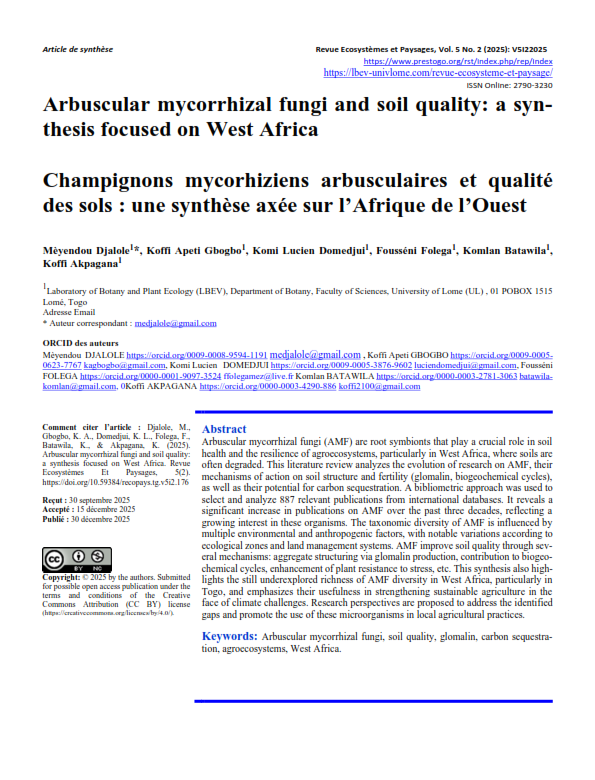
Arbuscular mycorrhizal fungi and soil quality: a synthesis focused on West Africa
Article Sidebar
Main Article Content
Abstract
Arbuscular mycorrhizal fungi (AMF) are root symbionts that play a crucial role in soil health and the resilience of agroecosystems, particularly in West Africa, where soils are often degraded. This literature review analyzes the evolution of research on AMF, their mechanisms of action on soil structure and fertility (glomalin, biogeochemical cycles), as well as their potential for carbon sequestration. A bibliometric approach was used to select and analyze 887 relevant publications from international databases. It reveals a significant increase in publications on AMF over the past three decades, reflecting a growing interest in these organisms. The taxonomic diversity of AMF is influenced by multiple environmental and anthropogenic factors, with notable variations according to ecological zones and land management systems. AMF improve soil quality through several mechanisms: aggregate structuring via glomalin production, contribution to biogeochemical cycles, enhancement of plant resistance to stress, etc. This synthesis also highlights the still underexplored richness of AMF diversity in West Africa, particularly in Togo, and emphasizes their usefulness in strengthening sustainable agriculture in the face of climate challenges. Research perspectives are proposed to address the identified gaps and promote the use of these microorganisms in local agricultural practices.
Article Details

This work is licensed under a Creative Commons Attribution 4.0 International License.
Droits d'auteur et licences
L’auteur est toute personne ayant contribué de façon significative à la conception, la recherche ou la rédaction de l'article. L’ordre de présentation des auteurs reflète le niveau de contribution de chacun.
Les auteurs cèdent une licence exclusive de première publication à la Revue Ecosystèmes et Paysages (online-ISSN : 2790-3230). Cette licence permet la production, la diffusion et l’indexation de l’article sur la plateforme de publication (prestogo), dans les bases d’indexation de contenus (ROAD, DOI, CROSSREF, DOAJ, CASSI, Mir@bel, OpenAlex, FAO AGRIS, OpenAir), Listes de classement des revues (AJOL, JPPS**), dans les répertoires de revues (EZB Electronic, Data Cite Comon), les préservateurs numériques (PKP-PN/LOCKSS PKP-PN/CLOCKSS) et les agrégateurs de contenu (Open Researcher and Contributor ID (ORCDI), Google scholar, Research Gate, World Cat OCLC, Scilit, Zenodo, LENS, R-Discovery).
Toutefois, la propriété intellectuelle et les droits d’auteur sur le contenu original demeurent à leurs auteurs. Les auteurs conservent les droits d'auteur des articles publiés et accordent à l'éditeur le droit non exclusif de publier l'article, d'être cité comme l'éditeur original en cas de réutilisation et de le distribuer sous toutes les formes et dans tous les médias. Les articles seront distribués sous la licence Creative Commons Attribution 4.0 International (CC BY 4.0). Les auteurs peuvent conclure des accords contractuels supplémentaires distincts pour la distribution non exclusive de l'article publié (par exemple, l'envoyer à un dépôt institutionnel ou le publier dans un livre), en mentionnant sa publication initiale dans ce journal.
Politique de confidentialité
Les noms et coordonnées des auteurs, évaluateurs (membres du comité de lecture) et collaborateurs, ainsi que celles de leurs organisations ou unités d’attache institutionnelles, recueillis dans le cadre des activités de la Revue Ecosystèmes et Paysages, sont traités de manière confidentielle. Ils ne seront jamais utilisés à des fins commerciales ou publiques, à l’exception de leur mention dans la signature des articles publiés.
La Revue Ecosystèmes et Paysages se réserve toutefois la possibilité d’exploiter ces informations pour ses propres activités, notamment afin de solliciter des articles, des collaborations ou des contributions, ainsi que pour transmettre ponctuellement des avis de diffusion de nouvelle parution par courrier électronique. Toute personne peut demander en tout temps à être retirée de ces listes.
Politique sur les frais de publication
La revue Revue Ecosystèmes et Paysages, est gratuite sur toute la ligne et applique les règles de frais de charges suivantes :
- Frais de publication : non
- Frais de soumission : non
- Frais d’exonération : non
- Frais de page : non
- Frais de page en couleur : non




References
Alaba, P., Abotsi, K. E., Adjonou, K., Segla, K. N., Kokutse, A. D., & Kokou, K. (2021). Mycorrhizal Status of Natural Stands of Pterocarpus erinaceus Poir.(Fabaceae) in Sudanian and Guinean Zones of West Africa. Annual Research & Re-view in Biology. https://doi.org/10.9734/arrb/2021/v36i630392
Amani, Y. F. C., M’bo, K. A. A., Cherif, M., Koné, D., & Kouamé, C. (2023). Diversité des Champignons Mycorhiziens à Arbuscules Associés aux Cacaoyers (Theobroma cacao L.) en Côte d’Ivoire. European Scientific Journal, ESJ, 19(27), 179.
Averill, C., Turner, B. L., & Finzi, A. C. (2014). Mycorrhiza-mediated competition between plants and decomposers drives soil carbon storage. Nature, 505(7484), 543–545.
Bainard, L. D., Klironomos, J. N., & Gordon, A. M. (2011). Arbuscular mycorrhizal fungi in tree-based intercropping sys-tems: A review of their abundance and diversity. Pedobiologia, 54(2), 57–61.
Bender, S. F., Plantenga, F., Neftel, A., Jocher, M., Oberholzer, H.-R., Köhl, L., Giles, M., Daniell, T. J., & Van Der Heijden, M. G. (2014). Symbiotic relationships between soil fungi and plants reduce N2O emissions from soil. The ISME Journal, 8(6), 1336–1345.
Bowles, T. M., Jackson, L. E., Loeher, M., & Cavagnaro, T. R. (2017). Ecological intensification and arbuscular mycorrhizas: A meta‐analysis of tillage and cover crop effects. Journal of Applied Ecology, 54(6), 1785–1793. https://doi.org/10.1111/1365-2664.12815
Cairney, J. W. G. (2000). Evolution of mycorrhiza systems. Naturwissenschaften, 87(11), 467–475. https://doi.org/10.1007/s001140050762
Cardoso, E. J. B. N., Vasconcellos, R. L. F., Bini, D., Miyauchi, M. Y. H., Santos, C. A. dos, Alves, P. R. L., Paula, A. M. de, Nakatani, A. S., Pereira, J. de M., & Nogueira, M. A. (2013). Soil health: Looking for suitable indicators. What should be considered to assess the effects of use and management on soil health? Scientia Agricola, 70, 274–289.
Cheng, L., Booker, F. L., Tu, C., Burkey, K. O., Zhou, L., Shew, H. D., Rufty, T. W., & Hu, S. (2012). Arbuscular Mycorrhi-zal Fungi Increase Organic Carbon Decomposition Under Elevated CO2. Science, 337(6098), 1084–1087. https://doi.org/10.1126/science.1224304
Cornejo, P., Meier, S., García, S., Ferrol, N., Durán, P., Borie, F., & Seguel, A. (2017). Contribution of inoculation with ar-buscular mycorrhizal fungi to the bioremediation of a copper contaminated soil using Oenothera picensis. Journal of Soil Science and Plant Nutrition, 17(1), 14–21.
Davison, J., Moora, M., Öpik, M., Adholeya, A., Ainsaar, L., Bâ, A., Burla, S., Diedhiou, A. G., Hiiesalu, I., Jairus, T., John-son, N. C., Kane, A., Koorem, K., Kochar, M., Ndiaye, C., Pärtel, M., Reier, Ü., Saks, Ü., Singh, R., … Zobel, M. (2015). Global assessment of arbuscular mycorrhizal fungus diversity reveals very low endemism. Science, 349(6251), 970–973. https://doi.org/10.1126/science.aab1161
Daynes, C. N., Field, D. J., Saleeba, J. A., Cole, M. A., & McGee, P. A. (2013). Development and stabilisation of soil struc-ture via interactions between organic matter, arbuscular mycorrhizal fungi and plant roots. Soil Biology and Biochemistry, 57, 683–694.
Diallo, M.-D., Duponnois, R., Guisse, A., Sall, S., Chotte, J.-L., & Thioulouse, J. (2006). Biological effects of native and ex-otic plant residues on plant growth, microbial biomass and N availability under controlled conditions. European Journal of Soil Biology, 42(4), 238–246.
Dieng, A., Ndoye, I., Duponnois, R., & Baudoin, E. (2014). Effects of Jatopha curcas L. plantation on soil bacterial and fun-gal communities. Soil Biology and Biochemistry, 72, 105–115.
Diop, T. A., Gueye, M., Dreyfus, B. L., Plenchette, C., & Strullu, D. G. (1994). Indigenous Arbuscular Mycorrhizal Fungi Associated with Acacia albida Del. In Different Areas of Senegal. Applied and Environmental Microbiology, 60(9), 3433–3436. https://doi.org/10.1128/aem.60.9.3433-3436.1994
Diouf, D., Duponnois, R., Ba, A. T., Neyra, M., & Lesueur, D. (2005). Symbiosis of Acacia auriculiformis and Acacia man-gium with mycorrhizal fungi and Bradyrhizobium spp. Improves salt tolerance in greenhouse conditions. Functional Plant Biology, 32(12), 1143–1152.
Doran, J. W., & Parkin, T. B. (1994). Defining and Assessing Soil Quality. In Defining Soil Quality for a Sustainable Envi-ronment (pp. 1–21). John Wiley & Sons, Ltd. https://doi.org/10.2136/sssaspecpub35.c1
Duponnois, R., Plenchette, C., Thioulouse, J., & Cadet, P. (2001). The mycorrhizal soil infectivity and arbuscular mycorrhi-zal fungal spore communities in soils of different aged fallows in Senegal. Applied Soil Ecology, 17(3), 239–251.
Ferrol, N., Azcón-Aguilar, C., & Pérez-Tienda, J. (2019). Arbuscular mycorrhizas as key players in sustainable plant phos-phorus acquisition: An overview on the mechanisms involved. Plant Science, 280, 441–447.
Gillespie, A. W., Farrell, R. E., Walley, F. L., Ross, A. R., Leinweber, P., Eckhardt, K.-U., Regier, T. Z., & Blyth, R. I. (2011). Glomalin-related soil protein contains non-mycorrhizal-related heat-stable proteins, lipids and humic materials. Soil Biology and Biochemistry, 43(4), 766–777.
Gnamkoulamba, A., Tounou, A. K., Agboka, K., Tchao, M., Tchabi, A., Adjevi, K. M., & Batawila, K. (2018). Evaluation du potentiel bioprotecteur des champignons mycorhiziens arbusculaires contre les nematodes phytoparasites et les insectes ravageurs du riz au Togo. Journal de La Recherche Scientifique de l’Université de Lomé, 20(3), 143–166.
Gnamkoulamba, A., Tounou, A. K., Tchabi, A., Kolombia, Y. A., Agboka, K., Tchao, M., Adjevi, A. K. M., & Batawila, K. (2018). Occurrence, abundance and distribution of plant-parasitic nematodes associated with rice (Oryza spp.) in different rice agroecosystems in Togo. International Journal of Biological and Chemical Sciences, 12(2), 618–635.
Harzing, A.-W. (2007). Publish or Perish. https://harzing.com/resources/publish-or-perish
Hodge, A., & Storer, K. (2015). Arbuscular mycorrhiza and nitrogen: Implications for individual plants through to ecosys-tems. Plant and Soil, 386(1–2), 1–19. https://doi.org/10.1007/s11104-014-2162-1
Lal, R. (1993). Soil erosion and conservation in West Africa. World Soil Erosion and Conservation, 7–25.
Lehmann, A., Zheng, W., & Rillig, M. C. (2017). Soil biota contributions to soil aggregation. Nature Ecology & Evolution, 1(12), 1828–1835.
Leifheit, E. F., Verbruggen, E., & Rillig, M. C. (2015). Arbuscular mycorrhizal fungi reduce decomposition of woody plant litter while increasing soil aggregation. Soil Biology and Biochemistry, 81, 323–328.
Leifheit, E. F., Veresoglou, S. D., Lehmann, A., Morris, E. K., & Rillig, M. C. (2014). Multiple factors influence the role of arbuscular mycorrhizal fungi in soil aggregation—A meta-analysis. Plant and Soil, 374(1–2), 523–537. https://doi.org/10.1007/s11104-013-1899-2
Lovelock, C. E., Wright, S. F., Clark, D. A., & Ruess, R. W. (2004). Soil stocks of glomalin produced by arbuscular mycor-rhizal fungi across a tropical rain forest landscape. Journal of Ecology, 278–287.
Ma, X., Xu, X., Geng, Q., Luo, Y., Ju, C., Li, Q., & Zhou, Y. (2023). Global arbuscular mycorrhizal fungal diversity and abundance decreases with soil available phosphorus. Global Ecology and Biogeography, 32(8), 1423–1434. https://doi.org/10.1111/geb.13704
McGahuey, M. (2021). Agroforesterie: Augmenter durablement la productivité des sols dans le Sahel ouest-africain. ETFRN News, 60, 221–394.
Öpik, M., Vanatoa, A., Vanatoa, E., Moora, M., Davison, J., Kalwij, J. M., Reier, Ü., & Zobel, M. (2010). The online database Maarj AM reveals global and ecosystemic distribution patterns in arbuscular mycorrhizal fungi (Glomeromycota). New Phytologist, 188(1), 223–241. https://doi.org/10.1111/j.1469-8137.2010.03334.x
Rillig, M. C., & Mummey, D. L. (2006). Mycorrhizas and soil structure. New Phytologist, 171(1), 41–53. https://doi.org/10.1111/j.1469-8137.2006.01750.x
Rillig, M. C., Ramsey, P. W., Morris, S., & Paul, E. A. (2003). Glomalin, an arbuscular-mycorrhizal fungal soil protein, re-sponds to land-use change. Plant and Soil, 253(2), 293–299. https://doi.org/10.1023/A:1024807820579
Rillig, M. C., Wright, S. F., Nichols, K. A., Schmidt, W. F., & Torn, M. S. (2001). Large contribution of arbuscular mycor-rhizal fungi to soil carbon pools in tropical forest soils. Plant and Soil, 233(2), 167–177. https://doi.org/10.1023/A:1010364221169
Singh, P. K., Singh, M., & Tripathi, B. N. (2013). Glomalin: An arbuscular mycorrhizal fungal soil protein. Protoplasma, 250(3), 663–669. https://doi.org/10.1007/s00709-012-0453-z
Smith, S. E., & Read, D. (Eds.). (2008). Mycorrhizal Symbiosis (Third Edition). In Mycorrhizal Symbiosis (Third Edition) (p. 768). Academic Press. https://doi.org/10.1016/B978-012370526-6.50020-9
Soumare, A., Manga, A., Fall, S., Hafidi, M., Ndoye, I., & Duponnois, R. (2015). Effect of Eucalyptus camaldulensis amendment on soil chemical properties, enzymatic activity, Acacia species growth and roots symbioses. Agroforestry Systems, 89, 97–106. https://doi.org/10.1007/s10457-014-9744-z
Tchabi, A., Burger, S., Coyne, D., Hountondji, F., Lawouin, L., Wiemken, A., & Oehl, F. (2009). Promiscuous arbuscular mycorrhizal symbiosis of yam (Dioscorea spp.), a key staple crop in West Africa. Mycorrhiza, 19(6), 375–392. https://doi.org/10.1007/s00572-009-0241-6
Tchabi, A., Coyne, D., Hountondji, F., Lawouin, L., Wiemken, A., & Oehl, F. (2008). Arbuscular mycorrhizal fungal com-munities in sub-Saharan Savannas of Benin, West Africa, as affected by agricultural land use intensity and ecological zone. Mycorrhiza, 18(4), 181–195. https://doi.org/10.1007/s00572-008-0171-8
Thiocone, K. M. O. (2024). Amélioration de la productivité de l’anacardier (Anacardium occidentale L.) au Sénégal par l’utilisation des champignons mycorhiziens à arbuscules. https://rivieresdusud.uasz.sn/handle/123456789/2278
Treseder, K. K., & Turner, K. M. (2007). Glomalin in Ecosystems. Soil Science Society of America Journal, 71(4), 1257–1266. https://doi.org/10.2136/sssaj2006.0377
Turner, B. L., Richardson, A. E., & Mullaney, E. J. (Eds.). (2007). Inositol phosphates: Linking agriculture and the environ-ment (1st ed.). CABI. https://doi.org/10.1079/9781845931520.0000
van Der Heijden, M. G., Martin, F. M., Selosse, M.-A., & Sanders, I. R. (2015). Mycorrhizal ecology and evolution: The past, the present, and the future. New Phytologist, 205(4), 1406–1423.
Verbruggen, E., Jansa, J., Hammer, E. C., & Rillig, M. C. (2016). Do arbuscular mycorrhizal fungi stabilize litter‐derived carbon in soil? Journal of Ecology, 104(1), 261–269. https://doi.org/10.1111/1365-2745.12496
Verbruggen, E., Van Der Heijden, M. G. A., Rillig, M. C., & Kiers, E. T. (2013). Mycorrhizal fungal establishment in agri-cultural soils: Factors determining inoculation success. New Phytologist, 197(4), 1104–1109. https://doi.org/10.1111/j.1469-8137.2012.04348.x
Wright, S. F., & Upadhyaya, A. (1996). Extraction of an abundant and unusual protein from soil and comparison with hyphal protein of arbuscular mycorrhizal fungi. Soil Science, 161(9), 575–586.
Wright, S. F., & Upadhyaya, A. (1998). A survey of soils for aggregate stability and glomalin, a glycoprotein produced by hyphae of arbuscular mycorrhizal fungi. Plant and Soil, 198(1), 97–107. https://doi.org/10.1023/A:1004347701584
Zhu, Y.-G., & Miller, R. M. (2003). Carbon cycling by arbuscular mycorrhizal fungi in soil–plant systems. Trends in Plant Science, 8(9), 407–409. https://doi.org/10.1016/S1360-1385(03)00184-5