
What ecological prediction for Cola nitida: an indigenous fruit species in Benin?
Article Sidebar
Main Article Content
Abstract
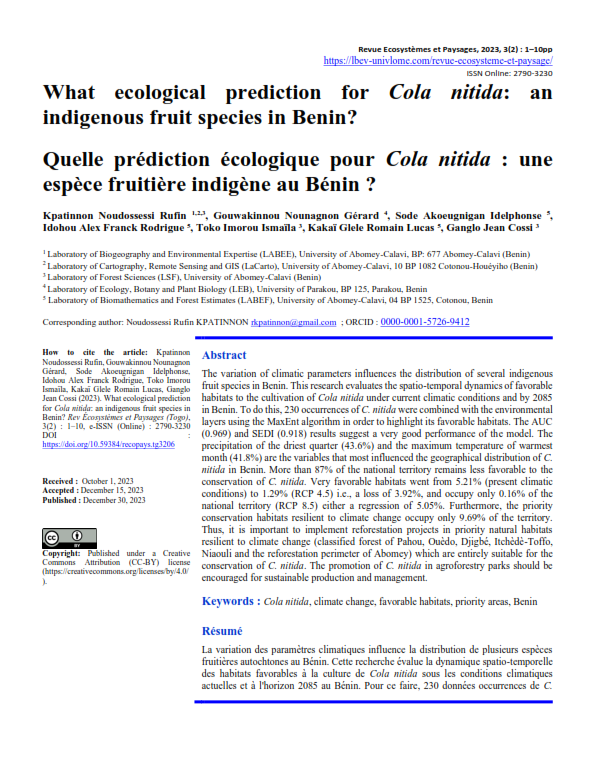
The variation of climatic parameters influences the distribution of several indigenous fruit species in Benin. This research evaluates the spatio-temporal dynamics of favorable habitats to the cultivation of Cola nitida under current climatic conditions and by 2085 in Benin. To do this, 230 occurrences of C. nitida were combined with the environmental layers using the MaxEnt algorithm in order to highlight its favorable habitats. The AUC (0.969) and SEDI (0.918) results suggest a very good performance of the model. The precipitation of the driest quarter (43.6%) and the maximum temperature of warmest month (41.8%) are the variables that most influenced the geographical distribution of C. nitida in Benin. More than 87% of the national territory remains less favorable to the conservation of C. nitida. Very favorable habitats went from 5.21% (present climatic conditions) to 1.29% (RCP 4.5) i.e., a loss of 3.92%, and occupy only 0.16% of the national territory (RCP 8.5) either a regression of 5.05%. Furthermore, the priority conservation habitats resilient to climate change occupy only 9.69% of the territory. Thus, it is important to implement reforestation projects in priority natural habitats resilient to climate change (classified forest of Pahou, Ouèdo, Djigbé, Itchèdè-Toffo, Niaouli and the reforestation perimeter of Abomey) which are entirely suitable for the conservation of C. nitida. The promotion of C. nitida in agroforestry parks should be encouraged for sustainable production and management.
Article Details

This work is licensed under a Creative Commons Attribution 4.0 International License.
Droits d'auteur et licences
L’auteur est toute personne ayant contribué de façon significative à la conception, la recherche ou la rédaction de l'article. L’ordre de présentation des auteurs reflète le niveau de contribution de chacun.
Les auteurs cèdent une licence exclusive de première publication à la Revue Ecosystèmes et Paysages (online-ISSN : 2790-3230). Cette licence permet la production, la diffusion et l’indexation de l’article sur la plateforme de publication (prestogo), dans les bases d’indexation de contenus (ROAD, DOI, CROSSREF, DOAJ, CASSI, Mir@bel, OpenAlex, FAO AGRIS, OpenAir), Listes de classement des revues (AJOL, JPPS**), dans les répertoires de revues (EZB Electronic, Data Cite Comon), les préservateurs numériques (PKP-PN/LOCKSS PKP-PN/CLOCKSS) et les agrégateurs de contenu (Open Researcher and Contributor ID (ORCDI), Google scholar, Research Gate, World Cat OCLC, Scilit, Zenodo, LENS, R-Discovery).
Toutefois, la propriété intellectuelle et les droits d’auteur sur le contenu original demeurent à leurs auteurs. Les auteurs conservent les droits d'auteur des articles publiés et accordent à l'éditeur le droit non exclusif de publier l'article, d'être cité comme l'éditeur original en cas de réutilisation et de le distribuer sous toutes les formes et dans tous les médias. Les articles seront distribués sous la licence Creative Commons Attribution 4.0 International (CC BY 4.0). Les auteurs peuvent conclure des accords contractuels supplémentaires distincts pour la distribution non exclusive de l'article publié (par exemple, l'envoyer à un dépôt institutionnel ou le publier dans un livre), en mentionnant sa publication initiale dans ce journal.
Politique de confidentialité
Les noms et coordonnées des auteurs, évaluateurs (membres du comité de lecture) et collaborateurs, ainsi que celles de leurs organisations ou unités d’attache institutionnelles, recueillis dans le cadre des activités de la Revue Ecosystèmes et Paysages, sont traités de manière confidentielle. Ils ne seront jamais utilisés à des fins commerciales ou publiques, à l’exception de leur mention dans la signature des articles publiés.
La Revue Ecosystèmes et Paysages se réserve toutefois la possibilité d’exploiter ces informations pour ses propres activités, notamment afin de solliciter des articles, des collaborations ou des contributions, ainsi que pour transmettre ponctuellement des avis de diffusion de nouvelle parution par courrier électronique. Toute personne peut demander en tout temps à être retirée de ces listes.
Politique sur les frais de publication
La revue Revue Ecosystèmes et Paysages, est gratuite sur toute la ligne et applique les règles de frais de charges suivantes :
- Frais de publication : non
- Frais de soumission : non
- Frais d’exonération : non
- Frais de page : non
- Frais de page en couleur : non




References
Adjahossou S.G.C., Gouwakinnou G.N., Houehanou D.T., Sode A.I., Yaoitcha A.S., Houinato M.R.B. et Sinsin B., 2016. Efficacité des aires protégées dans la conservation d’habitats favorables prioritaires de ligneux de valeur au Bénin. Bois et forêts des tropiques, 328(2) : 67-76. https://doi.org/10.19182/bft2016.328.a3130
Adomou A.C., Akoegninou A., Sinsin B., Foucault B. and van der Maesen L.J.G., 2007. Notulae Florae Beninensis, 13-Biogeographical analysis of vegetation in Benin. Acta Bot. Gallica., 154(2): 221-233. https://doi.org/10.1080/12538078.2007.10516053
Ali K.F.M.R. and Kpatinnon N.R., 2022. Spatiotemporal dynamic of the Land Use Units (LUU) of the Goroubi Classified Forest (GCF) in north Benin. Rev Écosystèmes et Paysages (Togo), Volume 2(2), 22-33. https://lbev-univlome.com/wp-content/uploads/2022/12/Ali-et-al.pdf
Ashraf U., Chaudhry M.N., Ahmad S. R., Ashraf I., Arslan M., Noor H. and Jabbar M., 2018. Impacts of climate change on Capparis spinosa L. based on ecological niche modeling. PeerJ 6:e5792 https://doi.org/10.7717/peerj.5792
Asseh E.E., Ake-Assi E. et Koffi K.J., 2019. Diversité biologique et influence des changements climatiques sur la distribution géographique de quelques espèces d’Acanthaceae en Côte d’Ivoire. Int. J. Biol. Chem. Sci. 13(2): 676-692 https://dx.doi.org/10.4314/ijbcs.v13i2.9
Busby J.W., Smith T.G., White K.L. and Strange S.M., 2010. Locating climate insecurity: where are the most vulnerable places in Africa? Springer, Berlin, 463-511. https://doi.org/10.1007/978-3-642-28626-1_23
Delvaux C., Sinsin B., Van Damme P., Beeckman H. et Van Damme P., 2010. Wound reaction after bark harvesting: microscopic and macroscopic phenomena in ten medicinal tree species (Benin). Trees, 24(5): 941–951. http://dx.doi.org/10.1007/s00468-010-0465-2
Djotan A.K.G., Aoudji A.K.N., Codjia S.A.F., Gbètoho A.J., Koura K. and Ganglo J.C., 2018. How far can climate changes help to conserve and restore Garcinia kola Heckel, an extinct species in the wild in Benin (West Africa). International Journal of Biodiversity and Conservation, Vol. 10(5): 203-213. https://doi.org/10.5897/IJBC2018.1180
Elith J., Graham C.H., Anderson R.P., Dudik M., Ferrier S., Guisan A., Hijmans R.J., Huettmann F., Leathwick J.R., Lehmann A., Li J., Lohmann L.G., Loiselle B.A., Manion G., Moritz C., Nakamura M., Nakazawa Y., Overton J.M., Peterson A.T., Phillips S.J., Richardson K., Scachetti Pereira R., Schapire R.E., Soberon J., Williams S., Wisz M.S. and Zimmermann N.E., 2006. Novel methods improve prediction of species’ distributions from occurrence data. Ecography, 29: 129-151. https://doi.org/10.1111/j.2006.0906-7590.04596.x
Fandohan A.B., Oduor A.M.O., Sode A.I., Wu L., Cuni-Sanchez A., Assédé E. et Gouwakinnou G.N., 2015. Modeling vulnerability of protected areas to invasion by Chromolaena odorata under current and future climates. Ecosystem Health and Sustainability, 1(6): 1-12. http://dx.doi.org/10.1890/EHS15-0003.1
Fandohan A.B., Gouwakinnou N.G., Fonton H.N., Sinsin B. et Liu J., 2013. Impact des changements climatiques sur la répartition géographique des aires favorables à la culture et à la conservation des fruitiers sous-utilisés : cas du tamarinier au Bénin. Biotechnol. Agron. Soc. Environ., 17(3): 450-462. https://popups.uliege.be/1780-4507/index.php?id=10186
Ganglo C.J., Djotan G.K., Gbètoho J.A., Kakpo S. B., Aoudji A.K.N., Koura K. and Tessi D.R.Y., 2017. Ecological niche modeling and strategies for the conservation of Dialium guineense Willd. (Black velvet) in West Africa. International Journal of Biodiversity and Conservation, Vol. 9(12): 373-388. https://doi.org/10.5897/IJBC2017.1151
Gbesso G.H.F., Tente A.H.B., Gouwakinnou N.G. et Sinsin A.B., 2013. Influence des changements climatiques sur la distribution géographique de Chrysophyllum albidum G. Don (Sapotaceae) au Benin. Int. J. Biol. Chem. Sci. 7(5) : 2007-2018. http://dx.doi.org/10.4314/ijbcs.v7i5.18
GIEC, 2013. Contribution du Groupe de travail I au cinquième Rapport d’évaluation du Groupe d’experts intergouvernemental sur l’évolution du climat ; Résumé à l’intention des décideurs. Suisse, 34 p. https://www.ipcc.ch/site/assets/uploads/2018/03/WG1AR5fr.pdf
Houetchegnon T.O., 2016. Etudes ethnobotanique, écologique et morphologique de Prosopis africana (guill., perrott. et rich.) Taubert au Bénin et impacts des changements climatiques sur l’espèce. Thèse de Doctorat Unique, Université de Parakou, Bénin, 175 p. https://www.lerf-up.com/public/uploads/documents/60387.pdf
IPCC, 2007. Climate Change: Impacts, Adaptation and Vulnerability. Working Groups II contribution to the Fourth Assessment Report of the Intergovernmental Panel on Climate Change. IPCC, Cambridge, university press, 987 p. https://www.ipcc.ch/site/assets/uploads/2018/03/ar4_wg2_full_report.pdf
Kakpo S.B., Aoudji A.K.N., GnanguènonGuéssè D., Gbètoho A.J., Koura K., Djotan G.K. and Ganglo J.C., 2019. Spatial distribution and impacts of climate change on Milicia excelsa in Benin, West Africa. J. For. Res., 32(1): 143-150. https://doi.org/10.1007/s11676-019-01069-7
Laouali A., Salamatou I.A., Boubacar M.M. et Ali M., 2020. Impact potentiel du changement climatique sur la dynamique des peuplements de Prosopis africana (G. et Perr.) Taub. à l’horizon 2050 au Niger. Journal of Applied Biosciences 155 : 16049 – 16059. https://doi.org/10.35759/JABs.155.9
Lebourgeois F., Pierrat J.C., Perez V., Piedallu C., Cecchini S. and Ulrich E., 2010. Simulating phenological shifts in French temperate forests under two climatic change scenarios and four driving GCMs. Int. J. Biometeorol., 54(5): 563-581. https://doi.org/10.1007/s00484-010-0305-5
Moilanen A., Anderson J.B., Eigenbrod F., Heinemeyer A., Roy B.D., Gillings S., Armsworth R.P., Gaston J.K. and Thomas D.C., 2011. Balancing alternative land uses in conservation prioritization. Ecological Applications, 21(5): 1419-1426. https://doi.org/10.1890/10-1865.1
Neuenschwander P., Sinsin B. et Goergen G., 2011. Protection de la Nature en Afrique de l’Ouest : Une liste rouge pour le Bénin. International Institute of Tropical Agriculture (IITA), 14-20. https://hdl.handle.net/10568/82964
Pearson R.G. and Dawson T.P., 2003. Predicting the impacts of climate change on the distribution of species: are bioclimate envelope models useful? Global Ecology and Biogeography, 12: 361-371. https://doi.org/10.1046/j.1466-822X.2003.00042.x
Phillips S. J., Anderson R.P. and Schapired R.E., 2006. Maximum Entropy Modeling of species geographic distributions. Ecological Modelling, 190: 231-259. https://doi.org/10.1016/j.ecolmodel.2005.03.026
Rayfield B., Moilanen A. and Fortin M.-J., 2009. Incorporating consumer-resource spatial interactions in reserve design. Ecological Modelling, 220: 725-733. http://dx.doi.org/10.1016/j.ecolmodel.2008.11.016
Schwartz M.W., 2012. Using niche models with climate projections to inform conservation management decisions. Biol. Conserv., 155: 149-156. https://doi.org/10.1016/j.biocon.2012.06.011
Sinadouwirou T.A., Assede E.P., Hegbe A., Orou H., Dicko A. et Biaou H.S., 2022. Effet des facteurs environnementaux et anthropiques sur les densités des populations adultes et de la régénération de Detarium microcarpum au Bénin. Rev Écosystèmes et Paysages (Togo), Volume 2(2), 69-84. https://lbev-univlome.com/wp-content/uploads/2022/12/Sinadouwirou-et-al.pdf
Thomas C.D., Cameron A., Green, M. Bakkenes R.E., Beaumont L.J., Collingham Y.C., Erasmus B.F.N., de Siqueira M.F., Grainger A., Hannah L., Hughes L., Huntley B., Van Jaarsveld A.S., Midgley G.F., Miles L., Ortega-Huerta M.A., Peterson T.A., Phillips O.L. and Williams S.E., 2004. Extinction risk from climate change. Nature, 427: 145-148. https://doi.org/10.1038/nature02121
Thorn J.S., Nijman V., Smith D. and Nekaris K., 2009. Ecological niche modelling as a technique for assessing threats and setting conservation priorities for Asian slow lorises (Primates: Nycticebus). Diversity and distributions, 15: 289-298. https://doi.org/10.1111/j.1472-4642.2008.00535.x
Toko Imorou I., 2020. Spatial distribution and ecological niche modelling of Triplochiton scleroxylon K. Schum., in the Guineo-Congolese region of Benin (West Africa). Int. J. Biol. Chem. Sci., 14(1): 32-44. https://doi.org/10.4314/ijbcs.v14i1.4
Van Zonneveld M., Koskela J., Vinceti B. and Jarvis A., 2009. Impact of climate change on the distribution of tropical pines in Southeast Asia. Unasylva, 231/232: 24-29. https://hdl.handle.net/10568/65902
Wunderlich R.F., Lin Y-P., Anthony J. and Petway J.R., 2019. Two alternative evaluation metrics to replace the true skill statistic in the assessment of species distribution models. Nature Conservation, 35: 97-116. https://doi.org/10.3897/natureconservation.35.33918
Zakari S., Arouna O., Toko Imorou I. et Yabi I., 2017. Impact des changements climatiques sur la distribution de deux espèces ligneuses fourragères (Khaya senegalensis et Afzelia africana) dans le bassin versant de la Sota, Bénin. Afrique Science 13(3) : 1-14. https://www.afriquescience.net/