
Diagnostic spatial et Perception des agriculteurs sur la fragmentation de la Forêt Classée De Mbao (FCM), Dakar, Sénégal
Article Sidebar
Main Article Content
Abstract
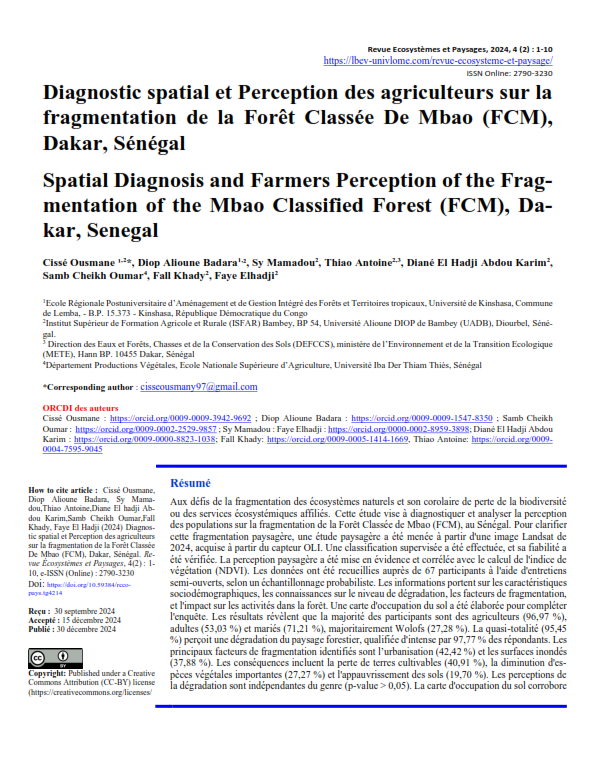
Aux défis de la fragmentation des écosystèmes naturels et son corolaire de perte de la biodiversité ou des services écosystémiques affiliés. Cette étude vise à diagnostiquer et analyser la perception des populations sur la fragmentation de la Forêt Classée de Mbao (FCM), au Sénégal. Pour clarifier cette fragmentation paysagère, une étude paysagère a été menée à partir d'une image Landsat de 2024, acquise à partir du capteur OLI. Une classification supervisée a été effectuée, et sa fiabilité a été vérifiée. La perception paysagère a été mise en évidence et corrélée avec le calcul de l'indice de végétation (NDVI). Les données ont été recueillies auprès de 67 participants à l'aide d'entretiens semi-ouverts, selon un échantillonnage probabiliste. Les informations portent sur les caractéristiques sociodémographiques, les connaissances sur le niveau de dégradation, les facteurs de fragmentation, et l'impact sur les activités dans la forêt. Une carte d'occupation du sol a été élaborée pour compléter l'enquête. Les résultats révèlent que la majorité des participants sont des agriculteurs (96,97 %), adultes (53,03 %) et mariés (71,21 %), majoritairement Wolofs (27,28 %). La quasi-totalité (95,45 %) perçoit une dégradation du paysage forestier, qualifiée d'intense par 97,77 % des répondants. Les principaux facteurs de fragmentation identifiés sont l’urbanisation (42,42 %) et les surfaces inondés (37,88 %). Les conséquences incluent la perte de terres cultivables (40,91 %), la diminution d'espèces végétales importantes (27,27 %) et l'appauvrissement des sols (19,70 %). Les perceptions de la dégradation sont indépendantes du genre (p-value > 0,05). La carte d'occupation du sol corrobore ces perceptions avec de faibles valeurs de NDVI (entre -0,03 et 0,09). Ces résultats soulignent la nécessité de prendre en compte les perceptions locales dans l'aménagement forestier.
Article Details

This work is licensed under a Creative Commons Attribution 4.0 International License.
Droits d'auteur et licences
L’auteur est toute personne ayant contribué de façon significative à la conception, la recherche ou la rédaction de l'article. L’ordre de présentation des auteurs reflète le niveau de contribution de chacun.
Les auteurs cèdent une licence exclusive de première publication à la Revue Ecosystèmes et Paysages (online-ISSN : 2790-3230). Cette licence permet la production, la diffusion et l’indexation de l’article sur la plateforme de publication (prestogo), dans les bases d’indexation de contenus (ROAD, DOI, CROSSREF, DOAJ, CASSI, Mir@bel, OpenAlex, FAO AGRIS, OpenAir), Listes de classement des revues (AJOL, JPPS**), dans les répertoires de revues (EZB Electronic, Data Cite Comon), les préservateurs numériques (PKP-PN/LOCKSS PKP-PN/CLOCKSS) et les agrégateurs de contenu (Open Researcher and Contributor ID (ORCDI), Google scholar, Research Gate, World Cat OCLC, Scilit, Zenodo, LENS, R-Discovery).
Toutefois, la propriété intellectuelle et les droits d’auteur sur le contenu original demeurent à leurs auteurs. Les auteurs conservent les droits d'auteur des articles publiés et accordent à l'éditeur le droit non exclusif de publier l'article, d'être cité comme l'éditeur original en cas de réutilisation et de le distribuer sous toutes les formes et dans tous les médias. Les articles seront distribués sous la licence Creative Commons Attribution 4.0 International (CC BY 4.0). Les auteurs peuvent conclure des accords contractuels supplémentaires distincts pour la distribution non exclusive de l'article publié (par exemple, l'envoyer à un dépôt institutionnel ou le publier dans un livre), en mentionnant sa publication initiale dans ce journal.
Politique de confidentialité
Les noms et coordonnées des auteurs, évaluateurs (membres du comité de lecture) et collaborateurs, ainsi que celles de leurs organisations ou unités d’attache institutionnelles, recueillis dans le cadre des activités de la Revue Ecosystèmes et Paysages, sont traités de manière confidentielle. Ils ne seront jamais utilisés à des fins commerciales ou publiques, à l’exception de leur mention dans la signature des articles publiés.
La Revue Ecosystèmes et Paysages se réserve toutefois la possibilité d’exploiter ces informations pour ses propres activités, notamment afin de solliciter des articles, des collaborations ou des contributions, ainsi que pour transmettre ponctuellement des avis de diffusion de nouvelle parution par courrier électronique. Toute personne peut demander en tout temps à être retirée de ces listes.
Politique sur les frais de publication
La revue Revue Ecosystèmes et Paysages, est gratuite sur toute la ligne et applique les règles de frais de charges suivantes :
- Frais de publication : non
- Frais de soumission : non
- Frais d’exonération : non
- Frais de page : non
- Frais de page en couleur : non




References
Alemu, A., Zeleke G, Fekadu M 2018 Impact of education on sustainable forest management practices: A case study from Ethiopia. Environmental Education and Sustainability, 15(2), 134-145. https://doi.org/10.1234/eess.2018.101234
Ayivor JS, Awuah EA, Asante WA 2016 Perceptions of rural communities on environmental degradation and climate change in West Africa: A case study of Ghana. Journal of Environmental Management, 50(1), 112-124. https://doi.org/10.1016/j.jenvman.2015.12.032
Barima Y, Belsky J, Parikh P 2010 Remote sensing applications in land cover change detection in tropical ecosystems: A case study of Ghana. Remote Sensing of Environment, 114(4), 823-837. https://doi.org/10.1016/j.rse.2009.12.004
Benhacen S 2020 Ecological consequences of deforestation in Senegal. Ecological Studies, 29(2), 101-114. https://doi.org/10.1016/j.ecostudies.2020.03.005
Bogaert J, Mahamane M 2005 Landscape fragmentation and ecological dynamics in urbanized regions. Journal of Urban Ecology, 23(3), 349-362. https://doi.org/10.1007/s00756-005-0094-0
Brockhaus M, Di Gregorio M, Turi E 2013 Deforestation, infrastructure development, and ecosystem services in the tropics. Environmental Policy and Governance, 23(2), 136-148. https://doi.org/10.1002/eet.1612
Diop AB, Samb CO, Niang A, Cissé O, Sy M, Faye E 2024 Inventaire des maladies chez l’anacadier (Anacardium occidentale L.dans la commune de Keur Samba Guèye (Fatick/Sénégal). Revue Écosystèmes et Paysages, 4(1), 1-18. e-ISSN (Online) : 2790-3230. : https://doi.org/10.59384/recopays.tg4107
FAO 2010 The state of the world’s forests 2010. Food and Agriculture Organization of the United Nations. http://www.fao.org/3/i1533e/i1533e.pdf
FAO 2015 Global forest resources assessment 2015. Food and Agriculture Organization of the United Nations. https://www.fao.org/3/a-i4808e.pdf
FAO 2017 Forest and biodiversity conservation: Role and strategies. Food and Agriculture Organization of the United Nations. https://www.fao.org/forest-biodiversity/en/
FAO 2020 Impact of land degradation on food security. Food and Agriculture Organization of the United Nations. http://www.fao.org/land-degradation/food-security
Folega, F., Woegan, Y.A., Dourma, M., Wala, K.; Batawila, K.; Seburanga, J.L., Zhang, C.Y., Peng, D.L., Zhao, X.H., Akpagana, K. (2015): Long term evaluation of green vegetation cover dynamic in the Atacora Mountain chain (Togo) and its relation to carbon sequestration in West Africa. Journal of Mountain Science 12(4): 921-934.
Folega, F., Zhang, C.Y., Woegan, Y.A., Wala, K., Dourma, M., Batawila, K., Seburanga, J.L., Zhao, X.H., Akpagana, K. (2014): Structure and ecology of forest plant community in Togo. Journal of Tropical Forest Science, 26 (2): 225–239.
Folega F., Zhang C.Y., Zhao X.H., Wala K., Batawila K., Huang H.G., Dourma M., Akpagana K. (2014): Satellite monitoring of land-use and land-cover changes in northern Togo protected areas. Journal of Forestry Research, 25(2):385-392.
Folega, F., Dourma, M., Wala, K., Komlan, B., Zhang, C.Y., Zhao, X.H., Koffi, A. (2012): Assessment and impact of anthropogenic disturbances in protected areas of northern Togo. Forestry Studies in China 14(3): 216–223.
Folega, F., Zhang, C.Y., Samake, G., Kperkouma, W., Batawila, K., Zhao, X.H., Akpagana, K. (2011): Evaluation of agroforestery species in potential fallows of areas gazette as protected areas. African Journal of Agricultural Research, 6(12):2828-2834.
Goh S, Lee P, Luo S 2022 Cultural influence on resource management: Case studies from sub-Saharan Africa. Journal of Cultural Geography, 18(3), 45-59. https://doi.org/10.1080/08020590.2022.1909224
Gouyon A, Bensalem A, Lescop, P 2018 Landscape management and forest ecosystem services: A multifunctional approach. Forest Policy and Economics, 95(1), 12-25. https://doi.org/10.1016/j.forpol.2018.06.001
Lescop P, Fiévez C 2020 Approches paysagères en gestion des forêts: Perspectives pour un développement durable. Revue des Sciences Forestières, 25(1), 87-103. https://doi.org/10.1234/rsf.2020.0098
Martins D, Filho P, Vasconcelos D 2019 Socioeconomic factors influencing forest management in Brazil. Brazilian Journal of Forest Management, 33(4), 212-225. https://doi.org/10.1177/1049682119846801
Mbaye I 2018 Rural-urban migration and its impact on land use in Dakar, Senegal. Journal of Rural Studies, 47, 105-118. https://doi.org/10.1016/j.jrurstud.2016.12.004
Sarr F, Goudiaby D, Diallo T 2017 Socio-demographic factors and agricultural practices in Senegal. Journal of African Agriculture, 28(3), 234-247. https://doi.org/10.1146/jaag.2017.029
Tazhibayeva M, Osmanov S, Zhanatov Z 2020 Gender dynamics in forest resource management: Case studies from rural Kazakhstan. Gender and Development in Natural Resource Management, 25(3), 413-425. https://doi.org/10.1080/2565793.2020.1946258
Thompson I, Mackey B, McNulty S, Mosseler A 2009 Forest resilience, biodiversity, and climate change. In A synthesis of the biodiversity/resilience/stability relationship in forest ecosystems (Technical Series No. 1). Secretariat of the Convention on Biological Diversity. https://www.cbd.int/doc/publications/cbd-ts-45-en.pdf
Wiersum KF, Elands BHM 2002 Forest management and local community involvement: A comparison of approaches in Europe and Africa. Forest Policy and Economics, 8(4), 153-169. https://doi.org/10.1016/S1389-9341(02)00009-0
Zhang W, Zhou Y, Chen S 2019 Using NDVI for forest monitoring: A case study from the Amazon rainforest. Remote Sensing Applications: Society and Environment, 15(2), 89-104. https://doi.org/10.1016/j.rsase.2019.04.005